
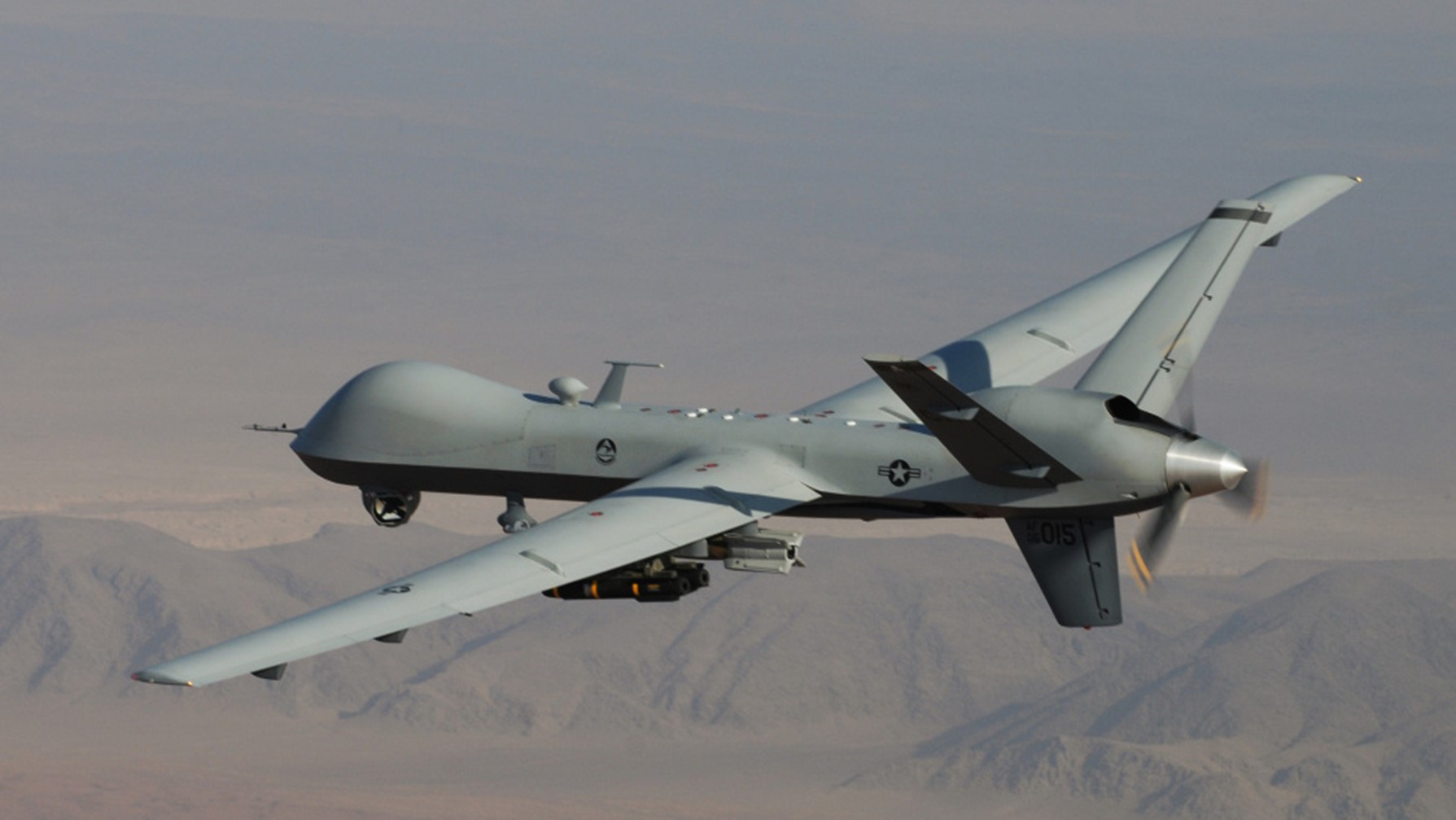

We have all seen the photo above at some point, or perhaps even seen such an aircraft in real life. This is a UAV, or unmanned aerial vehicle. These aircraft have neither a pilot nor any other crew on board; they can be remotely controlled from the ground, operate automatically along a pre-planned route, or function autonomously via complex dynamic systems. Although they are most commonly associated with the military, in practice they are also used for search and rescue, surveillance, traffic monitoring, weather monitoring and firefighting.
The origins of these craft date back to before the First World War, when Austria attacked Venice with an unmanned balloon filled with explosives. Whilst some balloons successfully carried out the attack, the wind pushed the rest back towards Austria. More similar to today’s UAVs, the Ruston Proctor Aerial Target project was launched on 12 September 1916 under the supervision of the Royal Flying Corps; they built a small aircraft that could be remotely guided to specific targets and carried various types of explosives.
From the above, we can see that remotely piloted vehicles have been with us for quite some time, so we can conclude that remote control technology has already been developed to the point where it could be applied to road vehicles.
As early as 1987, the advantages of remotely controlled vehicles were recognised as including better utilisation of vehicles, a better working environment for employees and better control over transport operations.
Solutions for remote vehicle control are also already present in the real world; in the video below, we can see how Volvo Trucks has introduced remotely controlled vehicles for use on construction sites. Volvo uses the MobileTronics VR01 system to control vehicles, which allows them to be moved locally via a radio link with limited speed and range.
In his research, Burke (2020) developed a concept for remote vehicle control at a location 18,500 km away via a 4G network. He presented an IP-based solution using a 4G mobile network to guide and control a semi-autonomous ground vehicle. The distance varied from a minimum of 18,500 km to a maximum of 20,000 km. This demonstrates the potential for using a low-cost communication network, built over the last twenty years, which can enable truly global vehicle network integration. They started with the problem that RF technology is very limited in terms of range (up to 10 km). They used an STM32 microcontroller with UART and I2C ports for GPS and RF connectivity. The system is supported by a Raspberry Pi computer with a separate digital camera and a Novatel modem, which connects the computer to the 4G network. The software solution used was Arudpilot Rover v.3.5.2, running on Windows 10 (virtual) and the Mission Planner backend. The 4G control uses the MavLink protocol to send commands over the internet. Amazon’s servers were used for the Windows virtual environment, specifically their AWS solution. Latency was around 200 ms and the video delay was 1 second.
However, in addition to the other positive impacts this solution would bring for both drivers and employers, it aligns perfectly with the development and roll-out of the 5G network. This will bring changes such as a significant reduction in latency, increased data transfer speeds and improved energy efficiency. The priority of the 5G network is to ensure seamless connectivity, regardless of location (at the top of a skyscraper or on the underground). 5G standards are built upon and utilise 2G, 3G, LTE, LTE-A, WiMAX and other technologies, combining them for optimal performance. 5G also enables the simultaneous connection of thousands of devices.
Take, for example, the first brain surgery in 2019, which was performed in China via the China Mobile network with support from Huawei. The surgeon performed the operation from a location some 3,000 km away from the patient. Since then, several more operations have been carried out in the same way.
We can see that if the network can support such feats with virtually zero latency, we believe we could manage the operator’s connectivity with a remote vehicle in real time in the same way. The problem we see in relation to connectivity is areas that are not yet covered by a 5G signal. For the time being, we could use satellite communication as a stopgap, but this is much slower and, above all, expensive.
Of course, as with autonomous vehicles themselves, this technology also requires support from the authorities and legislators. Furthermore, various safety organisations, which are responsible for the safety not only of the workplace but also of other road users, often stand in the way of progress.