

- 1. The role of simulation in preparing drivers for unpredictable conditions
- 2. Learning from mistakes without consequences
- 3. Technologies that enable a realistic experience
- 4. Simulators as part of compulsory education
- 5. Psychological aspect – more confidence on the road
- 6. The fun side of dangerous scenarios
- 7. The future of extreme simulations
1. The role of simulation in preparing drivers for unpredictable conditions
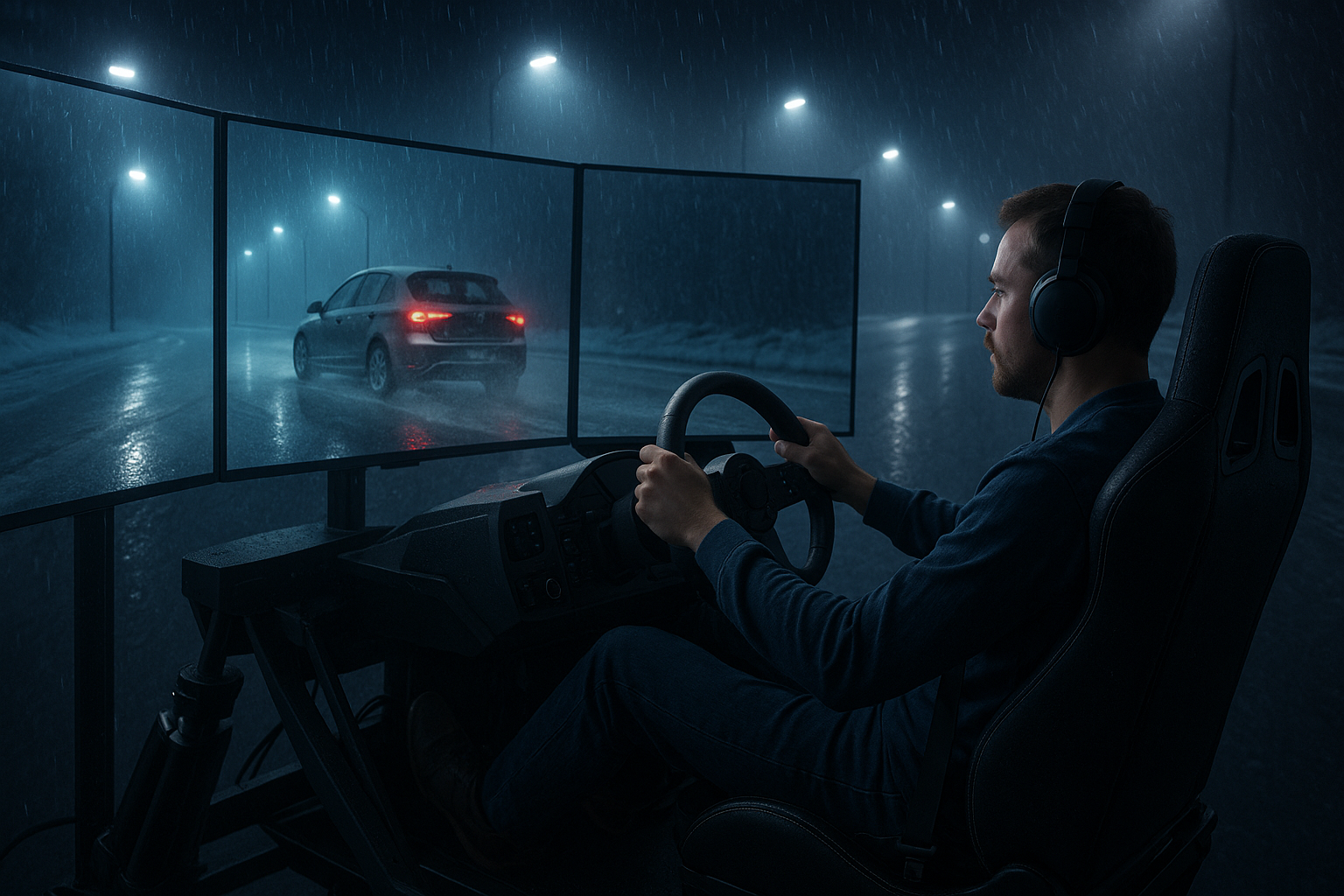
Simulating extreme conditions is a key part of modern driver training. Safety on the road largely depends on the ability to react correctly in critical moments – when there is aquaplaning, ice, thick fog or snowy conditions.
On the simulator, drivers can experience these situations without danger to themselves or the vehicle, which allows quick learning and development of reflexes in a fully controlled environment.
2. Learning from mistakes without consequences
One of the greatest advantages of simulators is the repeatability of scenarios. The driver can repeat the same situation – for example, slipping on ice or the sudden appearance of a pedestrian – several times until he achieves the correct response.
After the ride, there is an error analysis, where the instructor together with the driver reviews the footage, data on speed, braking force and reaction time. Such feedback is essential for progress and self-reflection.
3. Technologies that enable a realistic experience
Advanced simulators such as SIM83-MS06 combine several technologies that create complete immersion:
- The Motion Platform conveys the sensation of acceleration, skidding and braking.
- Visual realism with triple screens or VR glasses offers a perfect viewing angle.
- Sound and physical responses (shakers, steering torque, G-forces) add authenticity that every driver feels.
4. Simulators as part of compulsory education
The simulation of extreme conditions is becoming an increasingly important part of mandatory programs such as Code 95, ADR and safe driving courses.
Slovenian legislation already allows the inclusion of simulators in official programs, but the future will go even further – to mandatory simulation modules for all professional drivers.
For driving schools and companies this means lower costs, greater safety and greater training efficiency.
5. Psychological aspect – more confidence on the road
Simulations are not just for technical skills. An important part of the training is managing stress and panic.
When a driver successfully solves a dangerous situation several times, his confidence increases, which in turn reduces the risk in real traffic.
Measurements show that simulators significantly shorten reaction time when repeating similar situations on the road.
6. The fun side of dangerous scenarios
Extreme conditions can also serve as a promotional or competitive challenge.
In SIM 83 we regularly prepare rally, drift and “escape challenge” events, where participants compete in controlled extreme conditions.
Such events are an excellent combination of adrenaline, fun and learnings – ideal for companies, teambuildings and presentations of new simulators.
7. The future of extreme simulations
The future of development is going in the direction of:
- Artificial intelligence, which generates unique weather scenarios,
- combinations of VR and motion platforms for complete immersion,
- links to telemetry data from real rides, enabling customized analysis.
This makes the simulator not only a training tool, but also a digital laboratory for researching human behavior in traffic.