
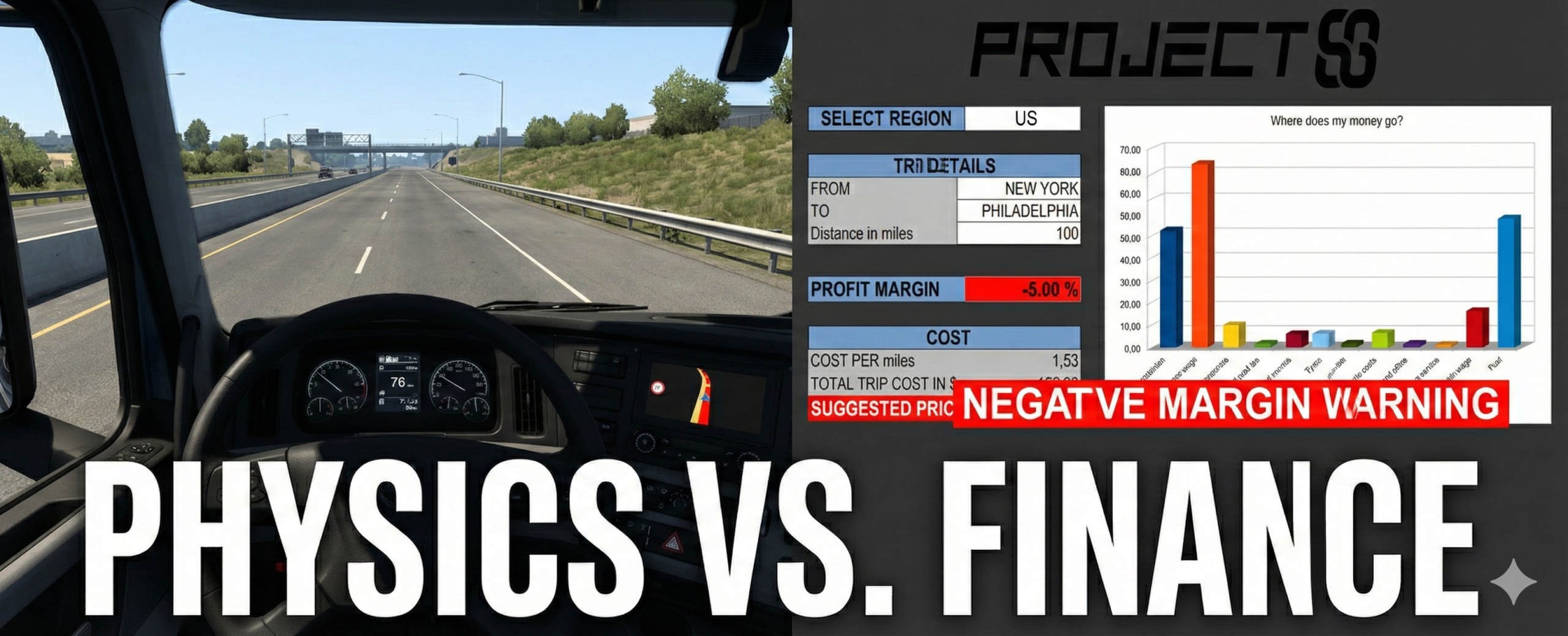

Introduction: The Illusion of Profitability
In the logistics industry, accuracy is everything. Fuel consumption is measured to the nearest deciliter, tire profile depth is monitored in millimeters and routes are optimized to save seconds. Despite this obsession with operational efficiency, the trucking industry faces a harsh reality: margins are razor thin. According to numerous surveys in the transport sector, the average operating margin is dangerously low, and many companies are recording negative returns despite full capacity.
Why is this happening? Why do companies that operate efficiently on the road lose money on the books?
The answer often lies in the tools we use to predict success. Modern driving simulators are engineering marvels. Using coefficients of friction, they can predict tire wear, calculate fuel consumption based on aerodynamic drag, and even estimate wear on parts based on driving aggressiveness. However, these are operational simulators, not financial simulators.

They tell you how much it costs to move a truck, but they don’t tell you how much it costs to own a business. They don’t take into account the silent killers of profitability: building depreciation, insurance premiums, taxes, parking lot maintenance and administration salaries. Today we’re going to expose those hidden costs and introduce a tool designed to fill that gap: Project 83 Advanced Transportation Cost Calculator & Freight Quote Engine.
The Simulator Trap: Physics vs. Economics
The data provided by top truck simulators is seductive. Whether used for driver training or route planning, these tools provide excellent feedback on variable costs.
- Variable costs are expenses that change in proportion to the company’s activity. In the transport industry, these are fuel, tyres, tolls and drivers’ salaries (if they are paid per kilometre).
Simulators are fantastic at calculating these. If you drive 1000 km, the simulator knows exactly how much diesel you used. However, the transportation company does not stop its expenses just because the wheels are not turning.
Fatal error:
If your truck is parked for a week due to lack of cargo, the driving simulator calculates your cost for that week as zero. Fuel consumption is zero; tire wear is zero. But in the real world, your cost for the week was probably several thousand euros. The insurance premium is due. The value of your truck has decreased (depreciation over time). The rent for the warehouse had to be paid. Your dispatcher was still expecting a salary.
If you rely solely on operational data from simulations to calculate transportation prices, you are effectively pricing your services as if your business only exists when the engine is running. This is the fastest way to bankruptcy.
Hidden fixed costs you ignore
For the exact calculation of the Break-Even Point, we have to look at the expenses that the “simulators” ignore. These are fixed costs – costs that exist regardless of the miles driven.
1. Depreciation beyond the truck
Most owner-operators calculate the depreciation of the truck. This is a standard item. What about the infrastructure that supports the truck?
- Building Depreciation: If you own a warehouse, garage or office, this asset loses value – or at least spends its “useful life”. In accounting terms, an office building has a long depreciation period, but if your business is based on a building worth €500,000, you have a silent cost of around €12,000 to €15,000 per year that your transport prices have to cover.
- Parking Depreciation: This is one of the most often overlooked expenses. Trucks are heavy. They destroy asphalt and concrete much faster than cars. The cost of repaving or repairing a parking lot is astronomical. If you don’t include a “parking reserve” in your own price per kilometer, a potential bill for €50,000 for yard renovation will instantly wipe out the entire year’s profit.

2. Wages that do not generate direct income
The simulator follows the driver. But who follows the disposer? Who follows the accountant?
- Salaries of Dispatchers: Dispatcher can manage five trucks. His salary is a fixed cost that must be split between these trucks. If one truck is under repair, the dispatcher still gets paid, which increases the burden on the remaining four vehicles.
- Accounting and administration: From reporting for excise duty refunds to payroll – the administrative burden of the transport industry is enormous. Whether you hire an outside company or do it yourself (which has an opportunity cost), it’s an expense that doesn’t fluctuate with mileage.
3. Compliance and Insurance
Insurance is probably the most painful fixed cost in 2026. Carrier liability (CMR), comprehensive insurance and cargo insurance are paid annually or monthly. The insurance company doesn’t care if you drove 10,000 kilometers or 10 kilometers.
In addition, road user charges and license fees are static. When you quote a customer based only on fuel and driver time, you are effectively paying these fixed costs out of pocket.
The break-even fallacy
The most common mistake in logistics is calculating the break-even point using only variable costs.
Incorrect formula:
Break-even = (Fuel + Tires + Driver’s salary) / Distance traveled
If you use this formula, you might think your cost is €1.40 per kilometer. Offer freight at €1.60 per kilometre, believing you’re making €0.20 in profit.
Reality:
When you factor in €2,000/month for insurance, €1,500/month for depreciation and €3,000/month for office wages and rent, your actual break-even point might be €1.85 per kilometer. With the €1.60 offer, you lose €0.25 for every kilometer driven. You are literally paying the customer to transport their cargo.
[Image of a graph of the break-even point in the transportation industry, showing the intersection of fixed and variable costs]
This is where the “simulator mentality” fails and this is where comprehensive financial tools become mandatory.
Solution: Project 83 Advanced Transportation Cost Calculator
Recognizing the gap between physical simulation and financial reality, we developed Project 83’s Advanced Transportation Cost Calculator & Freight Quote Engine.
This is not just a spreadsheet; is a comprehensive financial modeling tool designed specifically for the complexity of modern transportation. Unlike standard simulators, it forces you to face hidden costs before they face you.
Key Features:
- Celostno sledenje stroškom:Kalkulator vam omogoča vnos podrobnih podatkov, ki jih druga orodja pogosto spregledajo. Ima namenska polja za:
- Costs of facilities: Rent, utilities and building depreciation.
- Yard maintenance: Reservations for parking lot repairs and security.
- Support staff: Salaries of dispatchers, accounting and security managers.
- Financial costs: Interest on loans and factoring costs.
- True break-even analysis: The engine dynamically separates fixed and variable costs. It tells you exactly how many kilometers you need to drive just to cover your fixed liabilities, and then calculates the actual profitability of each subsequent kilometer.
- Built-in Freight Quote Generator: This tool changes the rules of the game. Once your expenses are entered, you don’t just get a report; get a bidding tool. You can enter a specific route (e.g. Ljubljana – Munich), and the engine will generate a minimum offer price that guarantees a certain profit margin. It ensures that you will never accidentally underestimate a load again.
- Scenario planning: “What if insurance increases by 10%?” “What if I employ another manager?” The calculator allows you to run these “What-If” scenarios to see how they affect your bottom line before you make a decision.
Why you need to switch from simulation to calculation
Simulators have their place. They are essential for training drivers to drive economically, which lowers your variable costs (fuel and maintenance). We love simulators for what they are.
But you can’t run a business based on physics alone. You run your business based on economics.
If you are an independent carrier or fleet manager, you are essentially running two businesses:
- Transport operation: Movement of goods (Variable costs).
- Logistics company: Asset ownership and risk management (Fixed costs).
Most people fail at other work because they don’t measure up. The Project 83 Advanced Transportation Cost Calculator measures both. Bridge the gap between the road and the bank account.
Take control of your margins today
The transportation industry is too competitive for guesswork. One underpriced deal can ruin a quarter. One overlooked depreciation schedule can ruin the year.
Don’t let hidden costs eat into your profits. It’s time to see the whole financial picture.
- Ready to professionalize your pricing? Buy Project 83 Advanced Transportation Cost Calculator & Freight Quote Engine here. It is refunded with the first correctly rated load.
- Want to start with the basics? Try our completely Free Trucking Fuel Calculator) and take control of variable fuel costs right away.
Don’t just drive a truck. Drive business.