
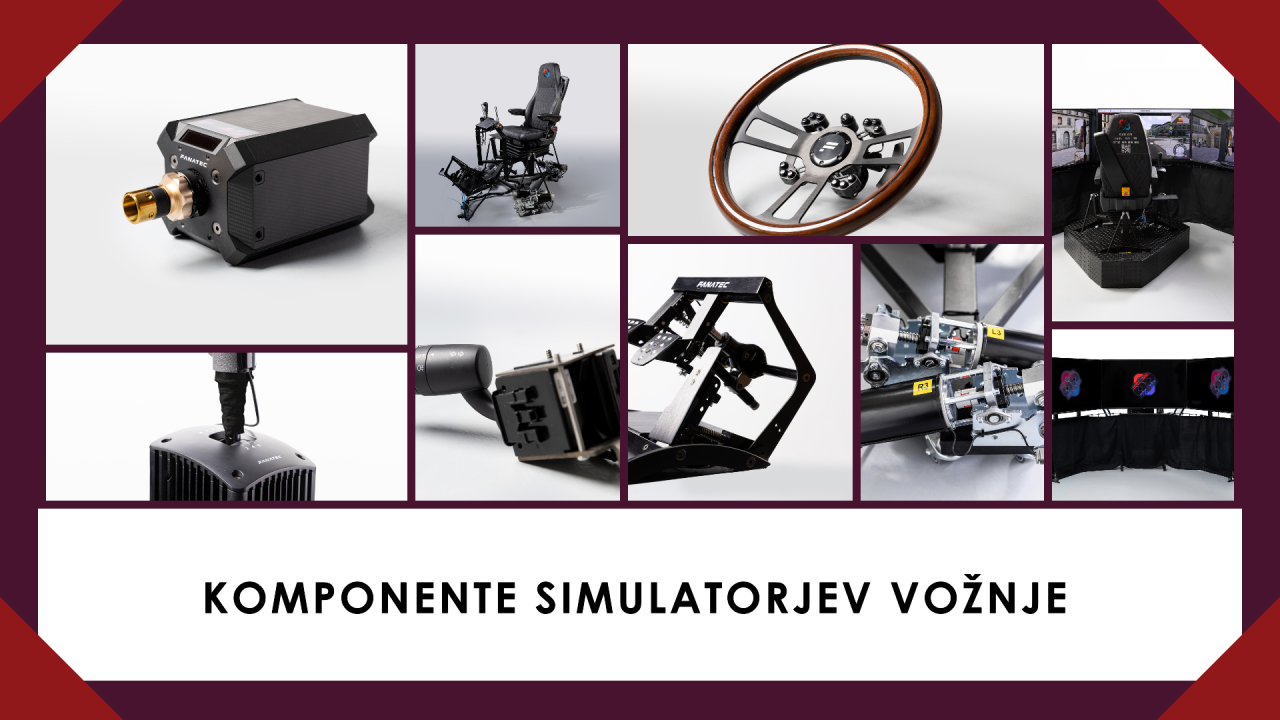

Driving simulators such as the SIM83-MS06 have become an indispensable tool in vehicle development and testing, driver training and road safety research. They offer a safe and controlled environment for simulating driving scenarios, which can be manipulated to test various aspects of driver behaviour, vehicle performance and more. But what exactly makes up a driving simulator? Let’s take a look at the essential components of a modern driving simulator.

Hardware components
1. Cockpit or driver’s cabin: This is the physical structure in which the driver sits and operates the simulator. It includes the driver’s seat, seatbelts and all the controls found in a real vehicle.
2. Motion platform: Many driving simulators use a motion platform to simulate the sensation of movement. A common type is the Stewart platform, also known as a hexapod platform, which can move in six degrees of freedom (up and down, side to side, forwards and backwards, as well as tilting, rolling and yawing) to mimic the movement of a car.
3. Visual display system: The visual system, a key element of the experience, can range from a single monitor to a set of screens providing a 180- or even 360-degree field of view. Some simulators also use virtual reality headsets for an even more immersive experience.
4. Audio system: Realistic sound is essential for the user as it can provide critical feedback. Engine noise, tyre sounds on different road surfaces and ambient sounds all contribute to the simulator’s realism.
5. Control devices: These devices include the steering wheel, pedals and gear lever, which are often actual car parts or highly accurate replicas that provide realistic feedback and force.
6. Computer systems: One or more powerful computers are required to run the simulation software, process driver data, and control the visual and motion systems.
Software components
1. Simulation software: This is the heart of the driving simulator, responsible for creating the virtual environment, vehicle dynamics and interactions with the driver. Based on the driver’s inputs and simulated physics, it calculates how the vehicle should behave.
2. Scene and environment generation: Software that creates the virtual world, including roads, traffic, buildings and weather conditions. It ensures that the driving experience is as close to real life as possible.
3. Data acquisition and analysis tools: These tools collect data on the driver’s performance, vehicle behaviour and all other relevant metrics for analysis.
4. Telemetry algorithms: These algorithms translate the vehicle’s movement into commands for the motion platform and ensure that the driver experiences acceleration and movement that are very similar to those they would experience in a real vehicle.
Integration and validation
Integrating these components is a complex process that requires careful calibration and validation to ensure the simulator behaves as realistically as possible. The aim is to create a tool that not only looks realistic but also accurately represents the physics of driving, from tyre grip on the road to the way the car responds to steering and braking.
Driving simulators are a testament to the convergence of technology and human experience, as they provide a platform on which both can be studied and improved. Whether for vehicle development, driver training or research, the components of a driving simulator work in harmony to create an invaluable tool for the automotive industry.
Driving simulators are complex systems that require a combination of high-tech hardware and sophisticated software to create realistic driving experiences. They are vital for the development of automotive technology and for improving driver safety and efficiency. As technology advances, so do the capabilities and applications of driving simulators, paving the way for even more innovative uses in the future.