

- The Looming Data Bottleneck and the Semantic Paradigm Shift
- The Evolution of compress83: A Step-by-Step Technical Breakdown
- v0.5: The Foundation of Skeleton Mode
- v0.6 & v0.7: Introducing the Neural Skinner
- v1.0: Building the Unified Proxy
- v1.1: Achieving Full Neural Teleportation
- The Endless Possibilities of an AI-Driven Future
- Developing the Next Horizon with SIM83
The Looming Data Bottleneck and the Semantic Paradigm Shift
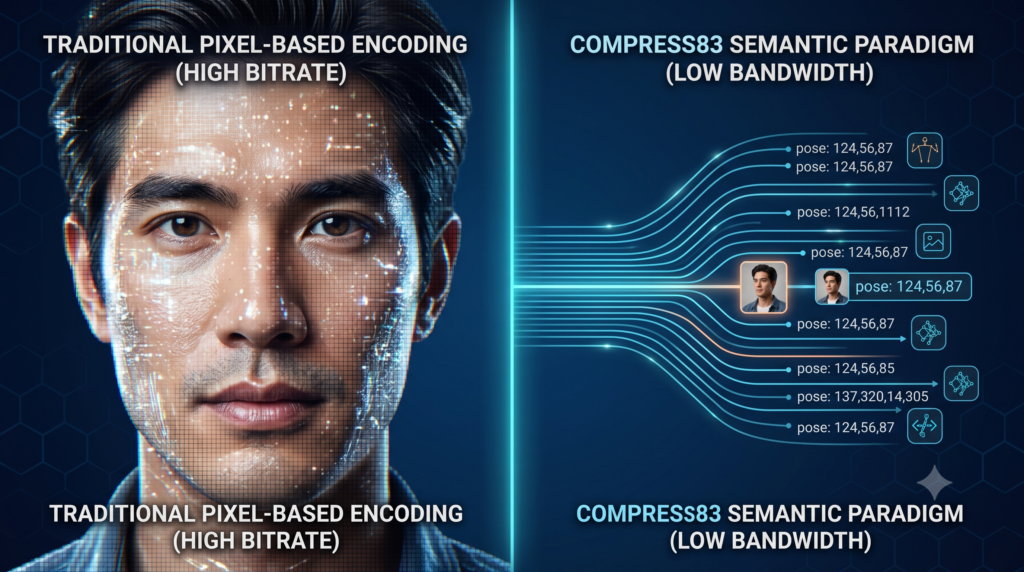
For decades, digital video communication has relied on a single foundational principle: capturing, encoding, transmitting, and decoding pixels. From the early days of H.261 to the modern efficiencies of H.264, H.265, and AV1, the core objective has remained unchanged. Traditional codecs look at a frame, find spatial and temporal redundancies, group pixels into macroblocks, calculate motion vectors, and discard mathematical data that the human eye is less likely to notice. While this pixel-based approach has powered the modern internet, it is rapidly approaching its theoretical limits. As the world demands higher resolutions, spatial computing environments, and instantaneous real-time communication, the sheer volume of data threatens to clog global network infrastructure.
At SIM83, we realized that solving this issue requires stepping away from the pixel altogether. Instead of asking how we can compress a picture of reality more efficiently, we asked a fundamental question: What if we don’t send the picture at all? What if we only send the underlying structural mechanics of reality and let artificial intelligence rebuild the visual world on the receiver’s end?
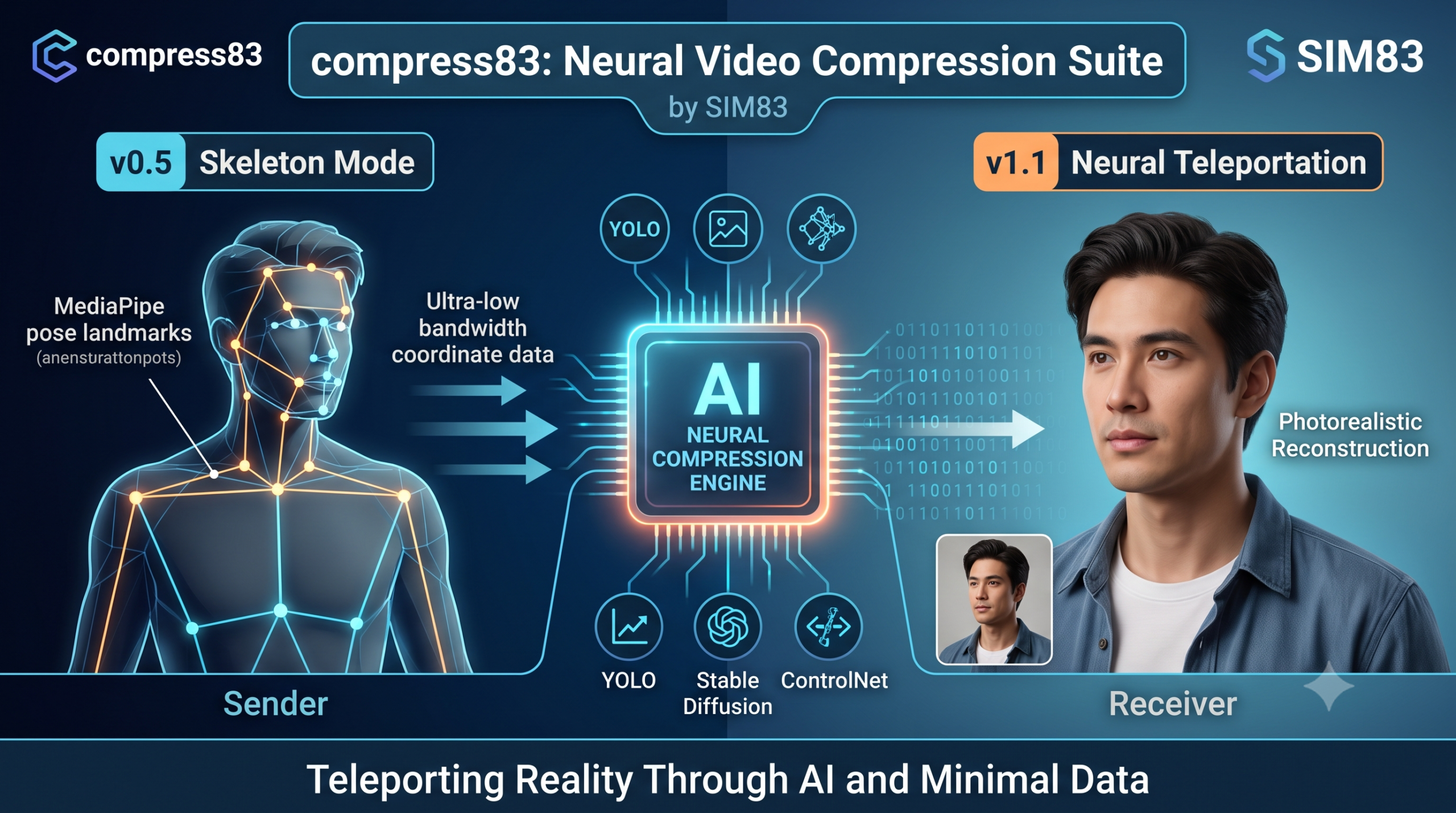
This is the core thesis behind our latest Proof of Concept (PoC), compress83. It represents an experimental neural video compression suite that shifts the paradigm from mathematical pixel compression to generative semantic reconstruction. By extracting only the minimal necessary telemetry of human interaction—such as 2D pose landmarks, 3D volumetric keypoints, and identity anchors—compress83 acts as an intellectual bridge, effectively “teleporting” the essence of a video across the network and synthesizing a photorealistic mirror image on the other side. This radically reduces file sizes and bandwidth requirements to a fraction of a percent of traditional streams, paving the way for a future where crystal-clear visual interaction can occur over the most constrained networks imaginable.
The Evolution of compress83: A Step-by-Step Technical Breakdown
Developing a neural video compression framework from scratch requires an iterative approach. The journey of compress83 spans multiple developmental versions, each building upon the last to move from abstract structural representations to flawless, high-fidelity neural teleportation.
v0.5: The Foundation of Skeleton Mode
The initial phase of the project, v0.5, focused purely on data minimalist extraction. To prove that a human being’s presence and movement could be compressed into numerical strings, we integrated Google’s MediaPipe framework. By deploying real-time vision pipelines, the system strips away backgrounds, clothing textures, lighting data, and facial features, isolating the subject down to 2D pose landmarks.
These landmarks represent a highly concise set of coordinate points mapping structural joints, such as shoulders, elbows, wrists, hips, and knees. Instead of transmitting a video stream consuming megabytes per second, v0.5 transmits a lightweight stream of coordinate coordinates, adding up to just a few kilobytes. On the receiving node, these coordinates are instantly rendered as a glowing abstract skeleton moving in perfect synchronization with the sender. While v0.5 lacked the visual texture of reality, it successfully demonstrated that human motion could be captured, packaged, and transmitted with virtually zero footprint.
v0.6 & v0.7: Introducing the Neural Skinner
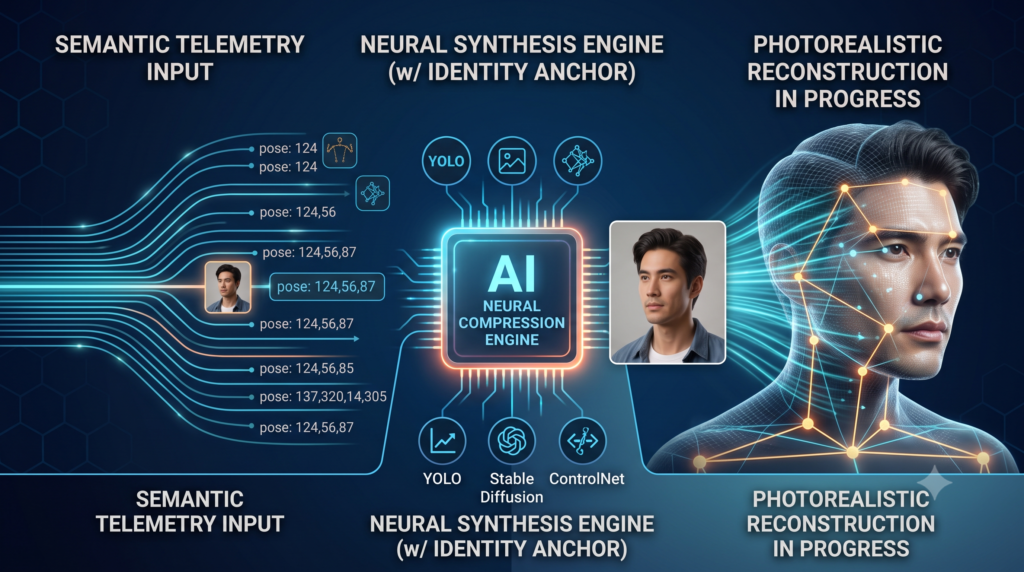
Once we established that structural data could be seamlessly sent across networks, the next challenge was re-clothing the skeleton. Versions 0.6 and 0.7 introduced the concept of the Neural Skinner, transforming abstract motion vectors back into recognizable human forms. This leap was achieved by combining the generative power of Stable Diffusion with the spatial guidance of ControlNet, specifically utilizing the OpenPose model.
The workflow operates by requiring a single high-quality reference picture of the sender—an identity anchor—which is stored locally on the receiver’s device. When the lightweight structural skeleton data arrives from across the network, ControlNet interprets the 2D coordinate wireframe as explicit spatial instructions. Stable Diffusion then utilizes the source image to reconstruct the video, frame by frame, synthesizing photorealistic clothing, skin textures, and environmental lighting based on the skeletal guide. The result is a synthesized video stream that mirrors the sender’s true appearance and movements, accomplished without a single original pixel ever crossing the network.
v1.0: Building the Unified Proxy
While the Neural Skinner proved the feasibility of generative video reconstruction, a truly viable communication suite requires more than just silent body tracking. It needs multi-modal synchronization and environmental awareness. Version 1.0, known as the Unified Proxy, addressed these demands by weaving together an advanced array of AI models to clean, optimize, and enrich the pipeline.
To capture the auditory dimension of communication, we implemented OpenAI’s Whisper model to handle real-time audio transcription and linguistic tokenization, ensuring that speech could be transmitted efficiently alongside motion data. To improve the accuracy of our structural tracking under varied environmental conditions, we swapped standard tracking for a more robust YOLO (You Only Look Once) pose estimation architecture, which accurately tracks human forms even in low-light environments or cluttered spaces. Finally, to eliminate visual artifacts, v1.0 incorporated median-blurring algorithms for clean background extraction, effectively separating the speaker’s dynamic silhouette from static environmental noise.
v1.1: Achieving Full Neural Teleportation
The current pinnacle of our PoC is version 1.1, aptly titled Neural Teleportation. This version elevates compress83 from an experimental rendering tool into a jaw-dropping, production-capable communication suite by refining micro-expressions, speech synthesis, and visual compositing.
The breakthrough in v1.1 centers around the integration of LivePortrait, an advanced model designed for high-quality, efficient portrait animation. While body poses are driven by structural landmarks, LivePortrait captures the micro-dynamics of the human face—including eye blinks, subtle shifts in gaze, jaw movements, and emotional nuances—and maps them onto the target identity anchor with astounding realism. To complement this, edge-tts handles advanced voice synthesis, reconstructing natural speech patterns from text or acoustic tokens. Finally, a seamless alpha-blended compositing engine handles the edges of the generated subject, allowing the reconstructed person to be integrated smoothly into any virtual background or real-time UI without harsh borders or unnatural artifacts.
The Endless Possibilities of an AI-Driven Future
The implications of the compress83 framework extend far beyond simple video conferencing. By decoupling communication from raw bandwidth, we open the door to a massive array of industrial, creative, and technological revolutions.
Imagine deep-space communications where astronauts can transmit full-motion briefings back to Earth using data limits normally reserved for text messages. Consider remote medical consultations in developing regions where satellite internet speeds are highly volatile; a rural doctor could receive real-time, photorealistic posture and motor-function feedback from a specialist thousands of miles away. In the entertainment industry, actors could perform complex motion capture sessions from their home offices, with high-fidelity digital twins synthesized globally in real-time.
Furthermore, this intersection of high-speed tracking and ultra-low latency optimization mirrors the evolution occurring in other high-performance sectors. For instance, in the realm of immersive simulation, drivers depend on rapid, deterministic feedback loop telemetries. Professional setups utilizing components like a high-torque Moza wheelbase or an ultra-rigid Trak Racer cockpit rely on instant data transmission to match human input with virtual reality physics. The exact same philosophy underpins compress83: reducing an immense amount of complex, real-world physical information down to its absolute structural essence so that a digital system can process and recreate it with zero perceived delay.
Developing the Next Horizon with SIM83
At SIM83, we believe that the true potential of artificial intelligence is unlocked when we stop viewing it as a tool for automation and start viewing it as an infrastructure for optimization. Our work with compress83 is an open invitation to developers, enterprise leaders, and visionaries to rethink how data moves across our world.
Whether it is optimizing complex streaming platforms, building immersive virtual worlds, or implementing cutting-edge generative frameworks, our team is dedicated to turning experimental AI proofs of concept into scalable realities. The technologies powering compress83—ranging from conditional neural synthesis to real-time spatial mapping—represent the foundational blocks of tomorrow’s internet architecture.
If you are interested in exploring how these advanced frameworks can optimize your operational workflows or want to keep up with our latest technical breakthroughs, be sure to bookmark our insights on the SIM83 Blog platform. The future isn’t about building bigger pipelines to move more pixels; it’s about building smarter systems that make pixels completely obsolete.
To dive deeper into our developmental philosophy and explore our technical ecosystem, check out the resources available on our core platform at SIM83 Main Site. For comprehensive deep dives into open-source machine learning architectures, you can explore the official Google AI Edge MediaPipe Solutions Guide as well as the open-source developments housed in the KlingAIResearch LivePortrait Repository.