
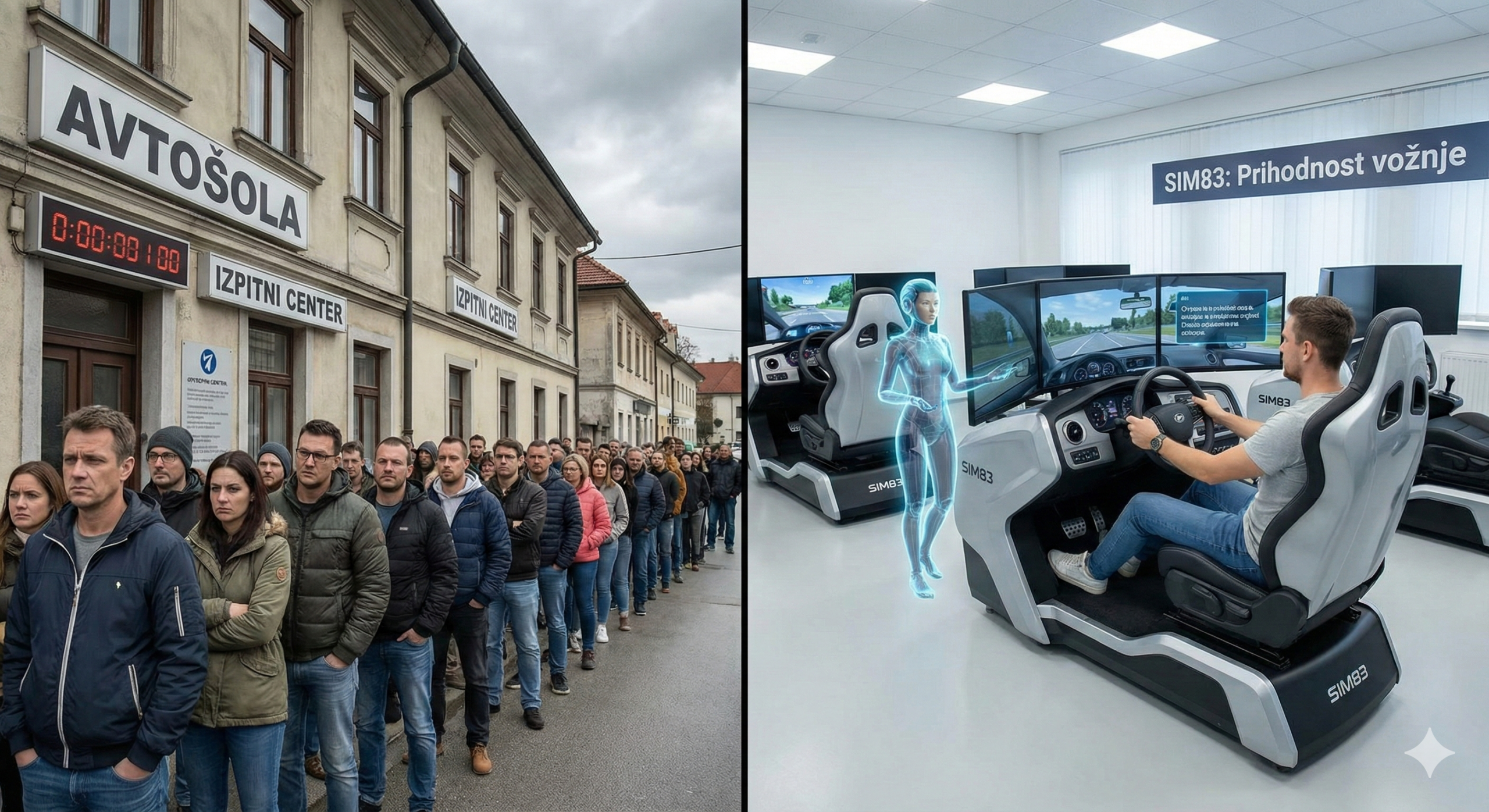

If you’re a learner driver in 2026, this frustration is all too familiar. You’ve mastered the clutch, you can parallel park with your eyes closed, and your instructor says you’re ready. But when you go to book your final test, you discover the first available slot isn’t for another six months.
This isn’t just a local problem; it’s a global phenomenon that is also putting significant pressure on Slovenia. Driving schools and test centres are facing unforeseen backlogs that show no sign of abating. But what exactly is causing this bottleneck and – more importantly – how can technology, specifically high-performance driving simulators, offer a way out?
Understanding the backlog: A perfect storm in 2026
To solve the problem, we must first understand its roots. The current delays in driving tests are the result of several factors that have combined to create a “perfect storm”:
- The Aftermath of Previous Years: Although 2020 seems a long way off, the “ripple effect” of past lockdowns is still reverberating through the system. Cancelled tests created a wave of candidates that the system has never fully managed to absorb.
- Shortage of exam markers: The role of an exam marker is extremely stressful and demanding. In recent years, many experienced markers have retired, and the recruitment of new ones is failing to keep pace with demand. Training a new marker takes longer than the system has available.
- The cycle of retakes: Because waiting times are so long, candidates often feel compelled to sit the exam before they are truly ready. They fear that if they wait, they will not get another opportunity for several more months. This leads to a lower pass rate and a greater number of people returning to the waiting list.
- Technical difficulties with registration: Despite digitalisation, registration systems often face surges in demand, causing further confusion and dissatisfaction among candidates.
How driving simulators are changing the game
This is where the SIM83 team’s mission becomes crucial. We don’t just build “games”; we build professional tools designed to bridge the gap between theory and actual driving on the road.
1. Reducing hours in the car without losing knowledge
Traditionally, the only way to prepare for the test was to spend 40 or more hours in a real car with an instructor. With simulators, learners can master the basics – gear changes, pedal control and mirror checks – in a controlled environment. This allows driving schools to use their vehicles and instructors more efficiently, as they can focus on complex manoeuvres on the road rather than basic vehicle control.
2. Safely managing stressful situations
One of the main reasons for failing the driving test is a lack of experience in hazard perception. In a real car, an instructor cannot force a pedestrian to suddenly step onto the road, or simulate a tyre blowout just for practice. At SIM83, we can do this with our driving simulators. Learners can face these stressful situations a hundred times until their reaction becomes second nature.
3. Objective data instead of subjective assessments
Human instructors are indispensable, but they can also have an “off day” or make subjective judgements. The simulator provides raw, objective data. It tracks exactly how many centimetres you were from the kerb, your reaction time to a red light, and whether you actually checked your blind spot. This feedback allows candidates to iron out their weaknesses before they even get into a car with an examiner.
Introducing the future: the AI driving instructor
At SIM83, we are always looking towards the next horizon. We are excited to mention our latest project, currently in development: the AI driving instructor.
Imagine a simulator that not only records your mistakes but understands why you made them. Our new project uses advanced machine learning to analyse the learner’s behaviour in real time.
- Personalised teaching: The AI adjusts the difficulty of the lesson based on the learner’s heart rate, eye movements and steering inputs.
- 24/7 availability: Unlike humans, the AI instructor doesn’t need sleep. It’s ready whenever the learner is.
- Consistency: AI ensures the same level of professional and patient instruction for every learner, every time.
By integrating artificial intelligence into our simulators, we aim to train drivers who are not just “good enough to pass the test”, but truly competent and confident. In the long term, this will increase the first-time pass rate and reduce the time an individual spends in the driving licence acquisition system.
Economic and social impact
Long queues are not just a nuisance; they have serious consequences. For many, a driving licence is a prerequisite for employment. For others, it is a matter of personal independence. By accelerating the learning process through simulation, we help people enter the labour market more quickly and reduce the financial burden of endless hours of extra driving lessons.
Conclusion: A smarter way to reach the goal
The backlogs will not disappear overnight simply by hiring new examiners. We need a fundamental shift in the way we teach driving. By moving a significant part of the training into the virtual world using SIM83 technology, we can ensure that when a candidate finally reaches the front of that long queue, they will pass their test at the first attempt.
The future of driving is digital, data-driven and safer for all of us. Are you ready to jump the queue?