

- Understanding the July 1, 2026 Legislative Mandate
- The Core Objectives Behind the New Regulation
- Who is Exempt? Navigating the Exceptions
- The Steep Learning Curve for Van Drivers
- The Severe Financial Implications of Non-Compliance
- Enter Tachobox83: The Ultimate Risk-Free Training Environment
- Building a Complete Simulation Setup for Driver Training
- Championing Sustainability Through the Circular Economy
- How Fleet Managers Can Prepare Today
- Conclusion
The logistics and road transport industry across the European Union is currently standing on the precipice of a massive regulatory shift. For decades, the rigorous tracking of driving times, resting periods, and border crossings was an obligation reserved almost entirely for heavy goods vehicles (HGVs) and large passenger buses. Drivers of light commercial vehicles (LCVs), commonly known as vans or “kombi” vehicles, enjoyed a relatively unrestricted operational environment. They could cross international borders, execute cabotage operations, and manage their daily schedules without the constant digital oversight of a tachograph device. However, this era of unmonitored light transport is rapidly coming to an end.
As part of the European Union’s broader Mobility Package, a sweeping set of legislative changes has been designed to harmonize the transport market, improve road safety, and ensure fair working conditions for all professional drivers. The most significant of these changes for the light transport sector will take full effect on July 1, 2026. From this date forward, strict new rules will govern the use of light commercial vehicles, fundamentally altering how courier services, express delivery companies, and independent transporters operate on European roads. Adapting to this change will require not only new hardware in the vehicles but an entirely new mindset and skill set for the drivers behind the wheel.
Understanding the July 1, 2026 Legislative Mandate
To fully grasp the magnitude of the upcoming changes, transport companies must look closely at the updated European legislation, specifically the amendments to Regulation (EC) No 561/2006. As clearly outlined in recent briefings by authoritative bodies such as the Chamber of Commerce and Industry of Slovenia (GZS), the new rules dramatically expand the scope of mandatory tachograph usage.
According to the updated Article 2 of the regulation, starting from July 1, 2026, the rules regarding driving times and rest periods will apply to the road transport of goods in international transport or cabotage operations where the maximum permissible mass of the vehicle, including any trailer or semi-trailer, exceeds 2.5 tonnes but does not exceed 3.5 tonnes. This means that standard delivery vans, which traditionally fell well below the 3.5-tonne threshold for tachograph mandates, are now squarely in the crosshairs of the new regulatory framework.
It is crucial to note that this mandate specifically targets vehicles engaged in cross-border activities. If a transport company operates a fleet of 3.2-tonne vans exclusively within the borders of a single EU member state (domestic transport), they are not immediately subject to this specific EU-wide mandate, although individual member states may choose to implement their own domestic rules. However, the moment that van crosses an international border to deliver goods, or engages in cabotage (transporting goods between two points within a foreign country), the vehicle must be equipped with a state-of-the-art smart tachograph of the second generation (G2V2).
This legislation applies equally to all drivers, regardless of whether they are citizens of the European Union or non-EU nationals employed by EU-based transport companies. Furthermore, drivers of these vehicles will now be fully subject to the strict rules regarding minimum wage postings when working abroad, further complicating the administrative burden for fleet managers and dispatchers.
The Core Objectives Behind the New Regulation
The introduction of tachographs to the LCV sector is not a punitive measure; rather, it is a calculated legislative effort to solve several long-standing problems within the European transport market. The primary objective is road safety. For years, the express delivery sector has been plagued by extreme pressure on drivers to meet tight deadlines, often resulting in dangerously long shifts without adequate rest. By enforcing the strict driving and resting times outlined in EU regulations—such as the maximum daily driving limit of 9 hours and the requirement for a 45-minute break after 4.5 hours of driving—the EU aims to drastically reduce fatigue-related accidents on European highways.
The second major objective is to ensure fair competition and combat social dumping. In the past, companies using fleets of vans could undercut traditional heavy haulage firms by ignoring rest times and paying drivers lower wages for longer hours. The mandatory use of G2V2 smart tachographs ensures a level playing field. These advanced devices feature automatic GPS recording of border crossings, remote early detection capabilities that allow enforcement officers to scan vehicles from the roadside without stopping them, and secure tracking of loading and unloading activities. This makes it nearly impossible for unscrupulous operators to bypass the rules without facing severe legal and financial repercussions. You can read more about the foundation of these rules in the official Regulation (EC) No 561/2006 documentation.
Who is Exempt? Navigating the Exceptions
While the new rules are extensive, the legislation does provide specific exemptions to prevent an undue burden on businesses and individuals who do not operate in the commercial transport sector. Understanding these exemptions is vital for business owners to determine whether they need to invest in new hardware and training.
Article 3 of the regulation stipulates that tachographs are not required for vehicles or combinations of vehicles with a maximum permissible mass not exceeding 7.5 tonnes that are used exclusively for non-commercial carriage of goods. “Non-commercial carriage” is strictly defined as any transport that is not for hire, reward, or on an own-account basis, for which no direct or indirect remuneration is received, and which does not generate any income.
More importantly for small businesses, there is a crucial exemption for vehicles between 2.5 and 3.5 tonnes used for the transport of goods for the company’s “own account.” This means if a tradesperson, such as a carpenter or a plumber, uses a van to transport their own tools, materials, or equipment to a job site, they do not need a tachograph—provided that driving the vehicle does not constitute the driver’s main activity. If the primary job of the employee is to perform the trade, and the driving is merely incidental to getting to the location, the exemption applies. However, if a company manufactures furniture and employs a dedicated driver whose sole job is to deliver that furniture across borders in a 3.5-tonne van, that driver will legally require a tachograph.
The Steep Learning Curve for Van Drivers
For professional truck drivers who have spent years navigating the complexities of digital tachographs, managing driving time is second nature. However, for the average van driver, this upcoming transition represents a massive paradigm shift. Most LCV drivers have historically operated with a “turn the key and go” mentality. The sudden requirement to rigorously log every minute of their working day introduces a profound psychological and operational burden.
Operating a modern smart tachograph is not entirely intuitive. A driver must learn the correct sequence for starting a shift: inserting their personal driver card, waiting for the system to read the chip, accurately answering prompts regarding manual entries, and correctly inputting the country where the daily working period begins. Throughout the day, the driver must constantly switch the tachograph between various modes. When the vehicle is moving, the device automatically records driving time. But when the van stops to load or unload cargo, the driver must manually switch the device to the “Other Work” (crossed hammers) mode. When taking a mandatory break, they must select the “Rest” (bed) symbol.
Furthermore, the new G2V2 tachographs require specific actions when crossing international borders. While the second-generation smart tachographs automatically record border crossings via GPS, drivers still need to understand how to interact with the device if GPS signals fail or when executing specific manual entries for periods of work or rest taken away from the vehicle.
The Severe Financial Implications of Non-Compliance
The anxiety surrounding the new legislation is well-founded, as the penalties for non-compliance are notoriously severe. European transport enforcement agencies do not take tachograph infringements lightly. Fines are levied not only against the transport company but often against the individual driver as well.
Failing to take a mandatory 45-minute break, driving beyond the daily 9-hour limit, or incorrectly entering data into the tachograph can result in fines ranging from several hundred to several thousand euros per infraction. More severe violations, such as driving without a driver card inserted, manipulating the tachograph data, or failing to declare manual entries, can lead to the immobilization of the vehicle, the loss of transport licenses, and even criminal prosecution.
For a courier who is unaccustomed to these strict rules, a simple mistake—like forgetting to switch the tachograph from “Rest” to “Other Work” while loading the van—can trigger a massive financial penalty during a routine roadside inspection. This reality makes comprehensive, hands-on training absolutely essential well before the July 2026 deadline.
Enter Tachobox83: The Ultimate Risk-Free Training Environment
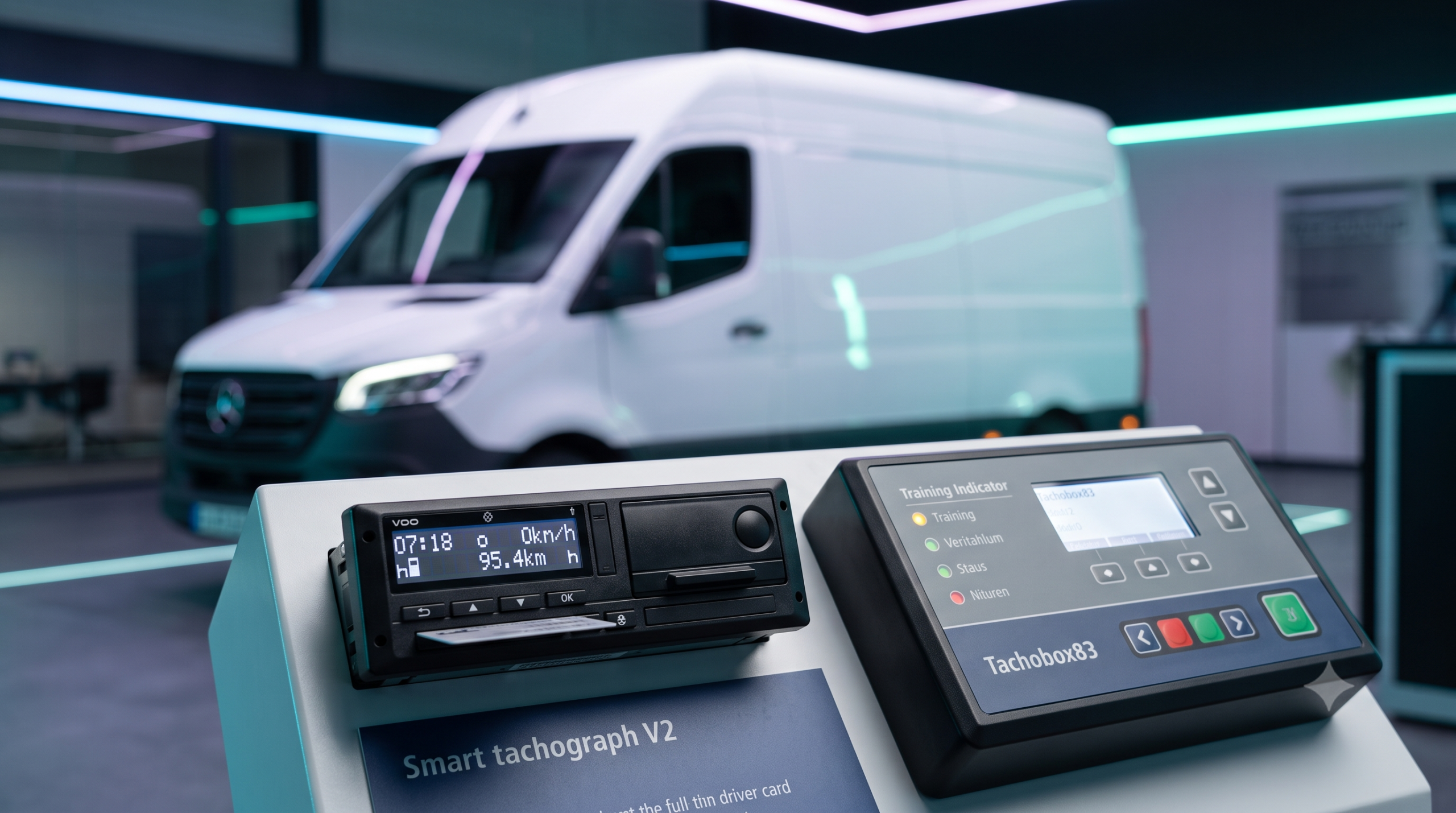
Recognizing the urgent need for accessible and effective training tools, SIM83 has developed a revolutionary product designed specifically to help transport companies, driving schools, and individual drivers prepare for the new legislation. The Tachobox83 system is an innovative, fully functional tachograph simulator that operates outside of a real vehicle.
Training a novice driver on a live tachograph installed in a real commercial vehicle is inherently risky. Any entry made with a real driver card is permanently recorded on the card’s chip and in the vehicle’s mass memory unit. If a trainee makes a mistake during a practice session—such as logging an incorrect manual entry or simulating a driving violation—that mistake is permanently logged and could potentially be penalized by authorities during a future inspection.
Tachobox83 eliminates this risk entirely. It allows drivers to interact with a genuine physical tachograph interface in a completely safe, offline classroom or office environment. Drivers can insert a training card and repeatedly practice the complex sequences of starting a shift, performing manual entries, changing activity modes, and ending a shift. If a mistake is made, there are no legal consequences and no permanent, unerasable records tied to a real commercial operation. This hands-on repetition is critical for building muscle memory and confidence, ensuring that when the driver finally sits in their van on July 1, 2026, operating the tachograph is second nature.
Building a Complete Simulation Setup for Driver Training
While practicing on a standalone Tachobox83 unit is incredibly beneficial, forward-thinking transport academies and driving schools are taking driver education a step further by integrating tachograph management into full-scale driving simulators. The true test of a driver’s competence is not just operating a tachograph on a static desk, but managing the device while also focusing on the road, navigating traffic, and handling the vehicle.
To create the ultimate driver training environment, organizations can build custom simulation rigs that perfectly mimic the cabin of a modern van or truck. The foundation of such a setup requires a highly stable and customizable chassis. For this, a Trak Racer cockpit is an exceptional choice, providing the rigid aluminum extrusion necessary to mount heavy equipment and accurately replicate a commercial vehicle’s seating position.
To simulate the physical sensation of driving a heavily loaded van, a powerful direct-drive steering wheel is essential. Incorporating a Moza Racing wheelbase offers incredibly precise force feedback, allowing the trainee to feel the weight of the vehicle, the resistance of the tires, and the nuances of the road surface. Alternatively, utilizing a comprehensive ecosystem like Fanatec allows for the integration of high-quality pedals with load-cell brakes, replicating the heavy braking feel of a fully loaded 3.5-tonne commercial van.
By mounting the Tachobox83 directly into the dashboard of this simulation rig, instructors can run comprehensive training scenarios. A trainee can be tasked with driving a simulated route from Slovenia to Austria. They must physically interact with the Tachobox83 to start their shift, drive the simulated route using the Moza or Fanatec hardware, pull over at a virtual rest stop to log their mandatory 45-minute break, and correctly document the border crossing. This level of immersive training ensures that drivers are deeply conditioned to handle the cognitive load of both driving and regulatory compliance simultaneously.
Championing Sustainability Through the Circular Economy
Beyond its immense value as a training tool, the Tachobox83 represents a significant triumph for environmental sustainability and responsible manufacturing. The European mandate for second-generation smart tachographs does not only apply to vans in 2026; it also requires the massive, ongoing retrofitting of all existing heavy goods vehicles currently operating across the continent.
As fleet managers upgrade their large trucks to the new G2V2 systems, hundreds of thousands of older analog and first-generation digital tachographs are being pulled out of dashboards. Historically, these perfectly functional, highly sophisticated electronic devices would be discarded, contributing to the growing global crisis of electronic waste (e-waste).
At SIM83, we view this waste not as trash, but as a valuable resource. Through our innovative engineering processes, we intercept these discarded tachographs before they reach the landfill. We carefully refurbish, reprogram, and repurpose them, giving them a second life as the core components of our Tachobox83 educational units.
By purchasing and utilizing a Tachobox83, transport companies are not only investing in the safety and compliance of their workforce but are also actively participating in sustainable business practices. You can learn more about how we are reducing electronic waste and exploring our deep commitment to sustainability by reading about our impact on the circular economy. This approach ensures that the valuable raw materials, microchips, and engineering that went into the original tachographs are maximally utilized, turning a legislative hardware transition into an opportunity for environmental conservation.
How Fleet Managers Can Prepare Today
The July 2026 deadline may seem distant, but for companies operating large fleets of light commercial vehicles, the time to act is now. The transition requires a multi-phased approach. First, fleet managers must audit their current operations to determine exactly which vehicles and routes will fall under the new international transport and cabotage regulations.
Next, budgets must be allocated not just for the purchase and installation of the G2V2 smart tachographs in the vehicles, but for the comprehensive training of the workforce. Waiting until the spring of 2026 to begin driver education will result in operational bottlenecks, driver frustration, and a high likelihood of early compliance fines.
By integrating the Tachobox83 into their onboarding and continuous training programs today, companies can systematically train their entire workforce in a low-stress, zero-risk environment. Drivers can ask questions, make mistakes, and learn the nuances of manual entries without the looming threat of a roadside inspection.
Conclusion
The inclusion of light commercial vehicles under the EU’s strict tachograph regulations marks a historic turning point for the European transport sector. While the goals of improved road safety and fair competition are universally beneficial, the practical reality of implementing these rules presents a formidable challenge for van drivers and fleet operators. Through proactive education, leveraging immersive simulation technology, and utilizing innovative, circular-economy-driven tools like the Tachobox83, companies can transform this daunting regulatory hurdle into an opportunity to build a safer, more professional, and highly compliant workforce. Do not wait for the fines to start rolling in—begin your preparation today.