

- What Is Hazard Perception and Why Real-World Driving Preparation Falls Short
- How Driving Simulators Train Muscle Memory and Rapid Reactions
- Building the Ultimate Home Training Simulator Setup
- Practical Simulator Drills for Back-to-School Road Hazards
- Safer Roads Start with Smarter Simulator Training
- What Is Hazard Perception and Why Real-World Driving Preparation Falls Short
- How Driving Simulators Train Muscle Memory and Rapid Reactions
- Building the Ultimate Home Training Simulator Setup
- Practical Simulator Drills for Back-to-School Road Hazards
- Safer Roads Start with Smarter Simulator Training
Every year, September marks a drastic change on public roads. As summer holidays draw to a close, millions of children return to classrooms, bringing a sudden surge in morning and afternoon road congestion. For drivers, this seasonal transition represents one of the most hazardous periods of the entire calendar year. School buses return to residential routes, young cyclists navigate busy intersections, and pedestrians—many of them young children who lack a full understanding of traffic hazards—fill crosswalks and sidewalks.
According to data compiled by official traffic safety organizations like the National Highway Traffic Safety Administration (NHTSA), child pedestrian fatalities and injuries spike significantly during peak school pickup and drop-off hours. In school zones and suburban neighborhoods, driver distraction or delayed reaction times by even half a second can lead to tragic consequences.
Several factors converge to make back-to-school roads particularly chaotic:
- Unpredictable Pedestrian Behavior: Young children frequently act on impulse. They may chase a rolling ball into the street, dart from between parked cars, or enter crosswalks without looking for oncoming traffic.
- School Bus Congestion: Frequent stops by school buses alter normal traffic flow. Rushed drivers often attempt risky passing maneuvers or fail to stop when flashing red bus lights are activated.
- Morning Glare and Low Visibility: Autumn brings changes in sunlight angles. Early morning glare can obscure vision precisely when children are walking to school or waiting at bus stops.
- Increased Volume and Time Pressure: Parents dropping off students and commuters navigating school-zone speed limits create high-density traffic jams, increasing driver frustration and impulsive decisions.
Navigating these challenges safely requires more than basic driving knowledge; it requires acute spatial awareness, rapid decision-making, and instinctive hazard perception. However, traditional driving instruction rarely provides the opportunity to practice high-risk emergency responses. That is where high-fidelity driving simulation technology step in.
What Is Hazard Perception and Why Real-World Driving Preparation Falls Short
Hazard perception is defined as a driver’s ability to anticipate, detect, and react to dangerous road situations before they result in a collision. Unlike basic car control—such as steering, braking, or changing gears—hazard perception is an advanced cognitive skill developed through exposure to high-risk situations over time.
In traditional driver training, students spend hours reading manuals, completing written exams, and driving under relatively calm, controlled road conditions. While this establishes foundational vehicle operation knowledge, it suffers from a major structural flaw: it cannot safely expose drivers to true emergency scenarios.
On real roads, a novice driver cannot practice swerving away from a child who suddenly steps off a curb, nor can an experienced driver repeatedly rehearse recovering control on a leaf-slicked wet road without risking vehicle damage or bodily harm. The real world relies on trial-and-error, where a single mistake during a learning moment can carry severe consequences.
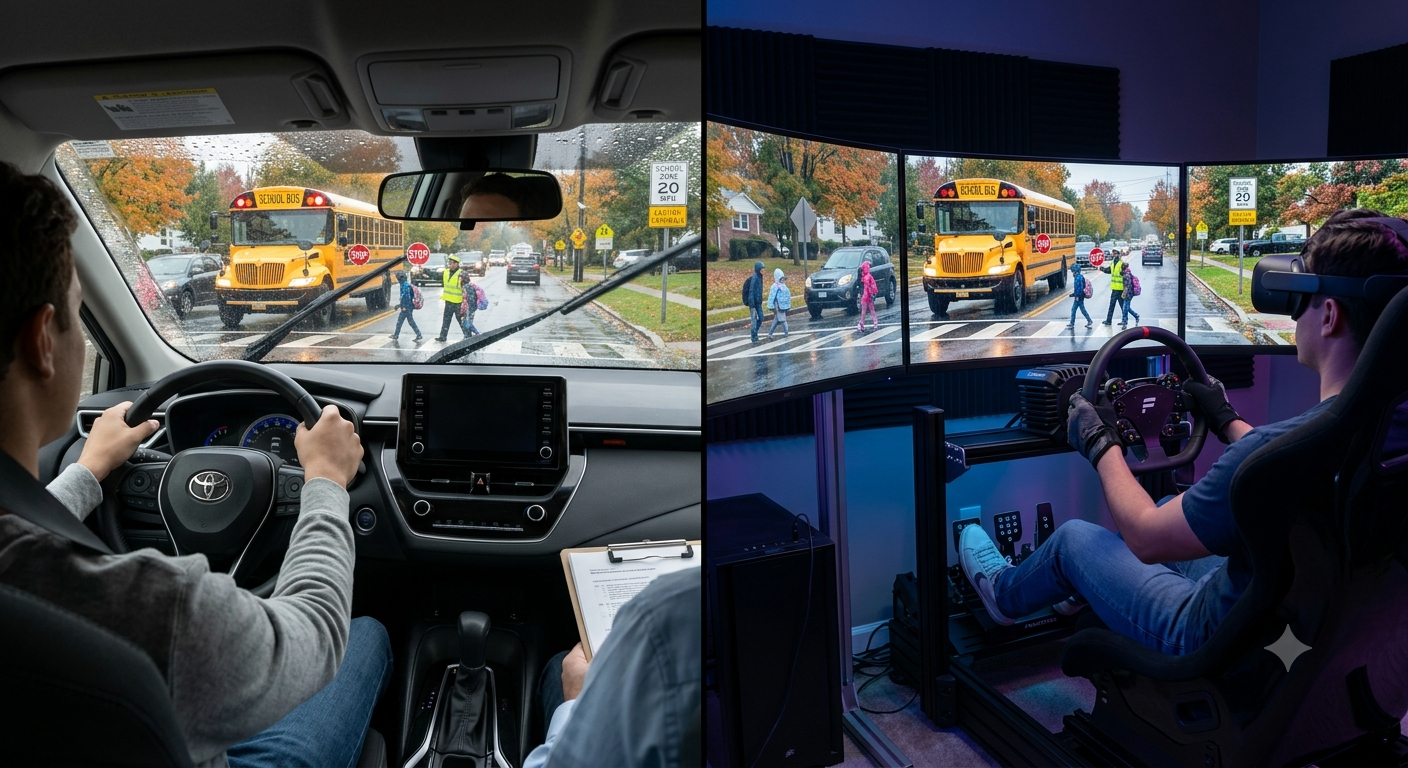
Furthermore, traditional video-based hazard perception tests—often used in driving licensing exams—are passive. Reading or watching a static 2D screen does not engage the driver’s physical senses, neuromuscular pathways, or realistic field of view. A Frontiers in Psychology study on driving simulation and hazard perception demonstrated that immersive simulator environments provoke more natural scanning behaviors, earlier speed adjustments, and far better spatial retention than passive visual tests.
To bridge the gap between classroom theory and life-saving real-world reflexes, simulation technology offers a safe, repeatable, and highly effective environment for drivers of all experience levels.
How Driving Simulators Train Muscle Memory and Rapid Reactions
Modern driving simulators are no longer mere entertainment systems; they are sophisticated training platforms capable of replicating real-world physics, vehicle dynamics, and unexpected environmental hazards with pinpoint precision. When paired with high-quality hardware, simulation provides a multi-sensory feedback loop that builds muscle memory faster than conventional driving.
1. Replicating High-Risk Pop-Up Scenarios Safely
In a simulated environment, software can generate custom scenarios that match the precise hazards of back-to-school traffic. Instructors or individual drivers can repeatedly experience scenarios where a pedestrian steps out behind a delivery van, a cyclist wobbles into traffic, or a vehicle ahead stops abruptly for a student crosswalk. Because these events occur safely in virtual space, drivers learn to recognize subtle early indicators—such as brake lights flickering down the street or shadows shifting between parked cars—allowing them to react fractions of a second faster.
2. Muscle Memory Under Emergency Braking and Swerving
When faced with an immediate obstacle, panicked drivers frequently lock up their brakes or oversteer, causing the vehicle to lose traction. Simulator training enables drivers to practice threshold braking and evasive steering repeatedly. By practicing these maneuvers dozens of times in realistic scenarios, the mechanical sequence of anti-lock braking modulation and smooth counter-steering becomes an automatic reflex rather than a panicked guess.
3. Expanding Field of View and Visual Scanning Rhythms
Inexperienced drivers tend to fixate directly ahead on the rear bumper of the car in front of them—a habit known as “target fixation.” Effective hazard avoidance requires dynamic visual scanning across a wide field of view. Multi-monitor simulator setups or Virtual Reality (VR) head-mounted displays force drivers to scan side mirrors, crosswalk entrances, and sidewalk blind spots continuously, building a habitual scanning rhythm that directly transfers to real-world driving.
4. Experiencing Traction Loss on Autumn Road Conditions
Autumn weather brings fallen leaves, rain showers, and early morning frost—all of which dramatically reduce tire grip near school zones. High-end force feedback wheel bases simulate subtle losses in tire traction, teaching drivers how reduced grip feels through the steering column before an actual skid occurs.
To explore how custom simulator hardware can be configured for personal or professional training, check out our comprehensive SIM83 Hardware Setup Guide.
Building the Ultimate Home Training Simulator Setup
To achieve true skill transfer from virtual environments to real-world roads, simulator hardware must provide accurate tactile, force, and visual feedback. Investing in quality equipment ensures that the physical inputs you deliver to the wheel and pedals match real vehicle dynamics.
Direct Drive Wheel Bases
Standard budget wheels rely on gears or belts, which produce notched, delayed, or dampened force feedback. Direct drive systems mount the steering wheel directly to an industrial motor, delivering instantaneous feedback on road texture, tire grip, and weight distribution. High-end solutions such as Moza Racing direct-drive wheel bases and ecosystem components from Fanatec sim hardware allow drivers to feel subtle shifts in vehicle balance the instant a tire loses traction or hits a road edge.
Precision Load-Cell Pedals
In real vehicles, braking distance is controlled by pedal pressure, not pedal distance. Load-cell pedal sets measure the physical force exerted by your foot rather than how far the pedal travels. This allows your brain to develop precise muscle memory for emergency stopping distances, enabling smooth, controlled stopping under stress.
High-Rigidity Aluminum Cockpits
Dynamic force feedback and heavy load-cell braking create intense physical forces that can flex cheap desk mounts or wooden frames. A rigid aluminum chassis, such as those manufactured by Trak Racer aluminum cockpits, provides a rock-solid foundation, ensuring that every Newton of force applied to the pedals translates into exact vehicle response without structural flex.
Motion Platforms for Full Motion Realism
To take spatial awareness and physical feedback to the absolute limit, full-motion platforms replicate g-forces, body roll, pitch under heavy braking, and subtle road bumps. Systems like DOF Reality motion simulators physically tilt and translate the seat, giving drivers visceral physical feedback whenever they accelerate, brake hard, or negotiate sharp swerves around unexpected obstacles.
For a detailed breakdown on selecting gear tailored to your specific training goals, read our guide on Building Your First SIM83 Rig.
Practical Simulator Drills for Back-to-School Road Hazards
To maximize the benefits of your simulator training during the back-to-school season, integrate these specific drills into your practice routine:
Drill 1: The 180-Degree Urban Hazard Scan
- Objective: Improve spatial awareness and eliminate blind-spot target fixation in heavy urban traffic.
- Execution: Set up a dense city route in your simulation software with high pedestrian density and parked cars along the curb. Drive at legal school-zone speed limits (20–30 km/h or mph). Focus your vision not on the vehicle ahead, but on scanning three zones: under the chassis of parked cars (looking for feet or bicycle wheels), sidewalk edges, and approaching crosswalks. Practice maintaining this continuous scanning loop without letting your speed creep up.
Drill 2: Emergency Threshold Braking and Swerve
- Objective: Execute full-force braking while maintaining full steering control to avoid sudden obstacles.
- Execution: Accelerate to 50 km/h on a simulated city street. Set a random event or marker where an emergency stop must occur. Practice applying maximum brake pressure instantly without locking the wheels, combined with a quick, smooth steering input into an open lane or shoulder, followed by immediate wheel centering. Repeat this drill 15 to 20 times until the maneuver feels fluid and relaxed.
Drill 3: Wet-Surface Skid Recovery
- Objective: Master vehicle control on slippery autumn roads covered in wet leaves or rain.
- Execution: Configure your simulator’s weather settings to wet asphalt with reduced grip levels. Drive through a series of sharp urban turns and practice sudden evasive maneuvers. Pay close attention to the force feedback in your wheel: when the steering suddenly feels “light,” it indicates front-tire hydroplaning or understeer. Practice easing off the accelerator and unwinding steering angle slightly to regain grip before applying controlled braking.
Safer Roads Start with Smarter Simulator Training
As streets fill with school buses, young pedestrians, and morning commuters, road safety requires heightened vigilance and split-second reaction capabilities. Traditional driver education provides the rules of the road, but immersive simulation builds the muscle memory, spatial processing, and defensive habits needed to navigate high-risk situations safely.
Whether you are a parent helping a newly licensed teen driver gain confidence, a daily commuter looking to sharpen your reflexes for autumn weather, or a fleet operator focused on safety compliance, simulator training transforms potential dangerous road hazards into manageable, practiced routines.
By combining professional software environments with high-fidelity hardware, you can turn your home or training center into a safe testing ground for real-world driving excellence. Explore SIM83’s full lineup of custom simulator rigs, direct-drive hardware, and expert setup services to elevate your driving precision and keep our roads safer for everyone this school year.