
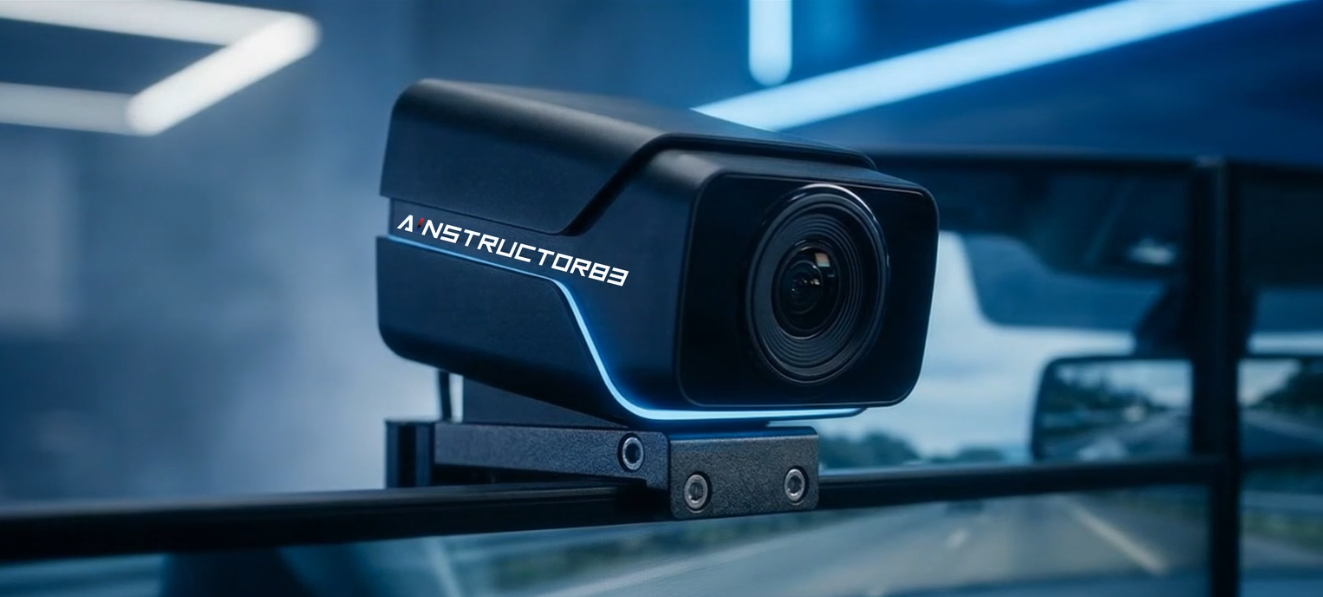

The future of driving instruction is officially here, and it is based on advanced computer vision. As of March 2026, the AInstructor83 innovation is moving from the development phase to full commercialisation, as the system has reached Technology Readiness Level (TRL) 8 and is fully qualified for market use. This groundbreaking innovation was developed by Miha Kadiš, MSc (Eng), within the company SIM 83. AInstructor83 is not merely a software update; it is a fundamental transformation of the way we approach driver training and road safety on platforms such as SIM 83. After 36 months of intensive development, the system automates learning and eliminates human error before the candidate even touches a real steering wheel.
The “blind spot” of traditional and digital learning
To truly understand the groundbreaking value of the AInstructor83 system, we must first analyse the central problem of today’s driver training. In the training process, the “human factor” represents by far the greatest variable and risk. According to official data from the World Health Organisation (WHO), human error is the direct cause of more than 90% of all road traffic accidents. Despite this alarming statistic, the status quo in driving schools and safe driving centres still relies almost exclusively on the physical presence of an instructor. This traditional approach entails extremely high costs, as an hour with an instructor in the European Union costs between €40 and €70, which also severely limits the scalability of learning.
The digitisation of learning and the use of simulators are not new ideas, but all existing driving simulators have so far focused exclusively on the vehicle’s own telemetry. These systems accurately measure speed, track the driving line, record offences and monitor the car’s position on the road, but they completely ignore the driver’s physical movements. This creates a so-called “blind spot” in digital learning. A system that does not detect how a learner holds the steering wheel, where they direct their gaze, or how ergonomically they are seated simply cannot correct incorrect motor habits. If these errors are not corrected in a safe simulation, they are directly transferred to the real-world environment, where they become life-threatening.
AInstructor83 ushers in the era of “Human-Centric” simulation
AInstructor83 was designed exclusively to address this blind spot. It is an advanced AI mentor for driving simulators that uses real-time computer vision to analyse the candidate themselves. The system introduces a completely new standard of learning, which we call “Human-Centric Simulation”. Using a high-resolution camera and deep neural networks, the system analyses the direct interaction between the human and the machine, employing algorithms for pose estimation and gaze tracking.
In practice, this means that AInstructor83 closely monitors the driver’s movements. The system checks for correct seating ergonomics, detects incorrect steering wheel grip in real time, and objectively confirms whether the candidate has actually looked in the mirror before performing a manoeuvre. This transforms a passive simulation into a proactive digital mentor. The system provides immediate corrections whilst driving and generates a comprehensive and objective assessment once the exercise is complete. This hybrid reporting combines analysis of driving technique with events in the simulator – for example, the system accurately records “Looked in the left-hand mirror 0.5 seconds too late before changing lanes”. This level of 100% consistency in feedback, which is not dependent on human fatigue or subjectivity, enables critical errors to be rectified more quickly within the virtual environment.
Economic optimisation and market potential
The AInstructor83 innovation is strategically designed to address challenges in several key market segments. At the B2B level (primary customers), it targets driving schools, safe driving centres and logistics companies seeking to drastically optimise the costs of initial training and standardise the quality of learning. At the B2G level (public sector), it offers educational institutions and the military rapid and safe staff training, whilst at the B2C level it offers end-users (candidates and Sim Racing enthusiasts) affordable practice without the pressure of an instructor.
For driving schools, the financial implications of implementation are revolutionary. Analyses show that automating the initial simulator sessions, where the candidate learns only posture and basic movements, can reduce costs for driving schools by up to 35%. With full implementation of the system across the entire learning process, we estimate that AInstructor83 reduces a driving school’s total operating costs by 12%. The company’s business model is not based on the sale of expensive, comprehensive simulators, but focuses on a licensing model (SaaS) and the sale of specialised hardware to upgrade existing systems, which significantly lowers the barrier to market entry.
It is important to emphasise that AInstructor83 does not replace human instructors, but rather enhances the professional quality of their work. Artificial intelligence takes over the routine and physically demanding task of monitoring basic movements (steering wheel and mirrors), allowing the instructor to focus on more complex teaching tasks and road ethics in later stages. This reduces burnout and increases the professional added value of the profession.
Link to Vision Zero objectives and ethical artificial intelligence
The impact of the AInstructor83 innovation extends beyond mere corporate economics; it is directly involved in achieving global strategic goals. The system is closely aligned with the Vision Zero initiative, which is a key strategic direction for the EU and aims for zero road fatalities by 2050. AInstructor83 directly supports these goals by preventing bad habits at the completely safe simulation stage (TRL 8), thereby preventing the transfer of incorrect motor patterns to the real road. The social impact is immense, as reducing the risk of accidents involving young drivers brings long-term positive effects for the entire national healthcare and insurance system.
Furthermore, the technology is fully compliant with the new European AI Act and the digital transformation strategy. It uses safe and ethical machine learning to enhance human skills and enables objective measurement of progress based on real data, rather than relying solely on subjective assessments. Development took place in close collaboration with driving schools (beta testing), where user feedback directly influenced the optimisation of AI models. You can read more about this process on our SIM 83 Blog.
The green transition and the circular economy in education
The educational process of learning to drive has traditionally placed a heavy burden on the environment. AInstructor83 positions itself here as a direct catalyst for the green transition in education. Its environmental impact is immediate and measurable. Every hour a learner spends on the simulator with the support of a digital instructor directly replaces an hour of driving in a real vehicle powered by fossil fuels.
On average, a driving school vehicle consumes around 6 litres of fuel per 100 kilometres driven. If, through effective simulation, we transfer just 10% of learning hours to a digital environment, we reduce CO2 emissions by more than 15% per candidate. Globally, this means that full implementation reduces emissions across the entire driving school training process by more than 10%, positioning the innovation as a pioneering sustainable practice within the industry. Driving schools also see significant savings on fuel, regular vehicle servicing and tyre wear.
The innovation is also committed to the principles of the circular economy, specifically upcycling. Rather than forcing customers to buy brand-new and extremely expensive devices, AInstructor83 enables the digital upgrade of existing simulators by adding minimal hardware – only one camera is required. This approach drastically extends the lifespan of existing hardware and prevents the accumulation of e-waste. For the learner, this efficiency means faster learning, a shorter time to passing the driving test and, consequently, a lower financial outlay.
Technological excellence for the global market
Due to the uniqueness of the approach, the competitive advantage is enormous. Competitors mostly focus on vehicle development or software without external driver observation. AInstructor83 is currently the only solution on the market that offers specific real-time analysis of correct hand technique and eye movement, whilst remaining hardware-agnostic and affordable.
As the “language” of correct driving technique is universal and entirely independent of specific local legislation in individual countries, the potential for internationalisation and penetration of foreign markets is exceptionally high. This confirms AInstructor83’s status as a breakthrough solution poised to transform global road safety standards.